Artificial Intelligence
Learn Your Way : Google in learning at school

Generative artificial intelligence (generative AI) no longer just writes texts or creates images, it is now entering the classroom. On September 16, Google’s research team unveiled an ambitious prototype called Google Learn Your Way, an interactive experience designed to reinvent the school textbook through AI. Available on Google Labs, this initiative is more than just a tech gadget; it is built on solid educational principles and supported by promising research results. For tech enthusiasts as well as educators, Google Learn Your Way marks a turning point in how AI can personalize and enhance learning.
Why rethink the school textbook with AI?
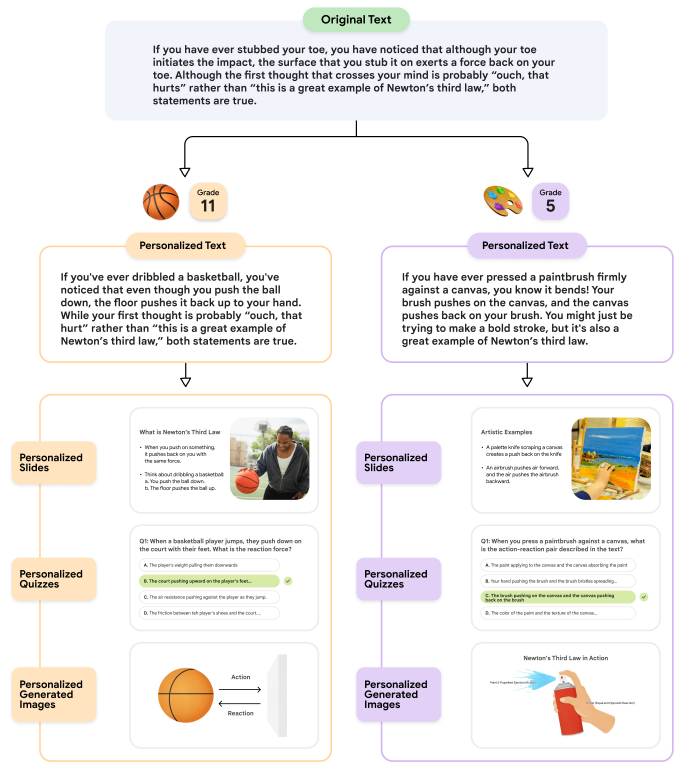
For decades, school textbooks have been static tools designed for an average audience. They do not adapt to a student’s level of understanding, personal interests, or learning style. This observation is what motivated Google’s researchers. With Google Learn Your Way, the goal is to transform a PDF school textbook into a dynamic, multimodal, and personalized experience. The idea? To allow each learner to choose how they want to learn, by reading, listening, visualizing mind maps, or answering interactive quizzes, all tailored to their academic level and personal passions (sports, music, cooking, etc.).
Technically, this project is based on LearnLM, a family of AI models specifically designed for education and now integrated into Gemini 2.5 Pro. The process takes place in two stages: first, the original content is “re-leveled” according to the student’s academic level indicated by the user; then, the generic examples are replaced with personalized analogies. For instance, a physics text might reference football for a sports enthusiast or music for a music lover. This initial personalization then serves as the foundation for generating multiple learning formats.
An interactive, science-backed experience
The interface of Google Learn Your Way offers five complementary formats: enriched text with images and integrated questions, section-based quizzes to test comprehension in real time, narrated slides resembling a recorded lecture, audio lessons in the form of dialogues between an “AI teacher” and a “virtual student,” and finally mind maps to visualize the structure of knowledge. Each format is not only accessible but also interconnected. If a quiz reveals a gap, the system guides the learner back to the relevant content for review.
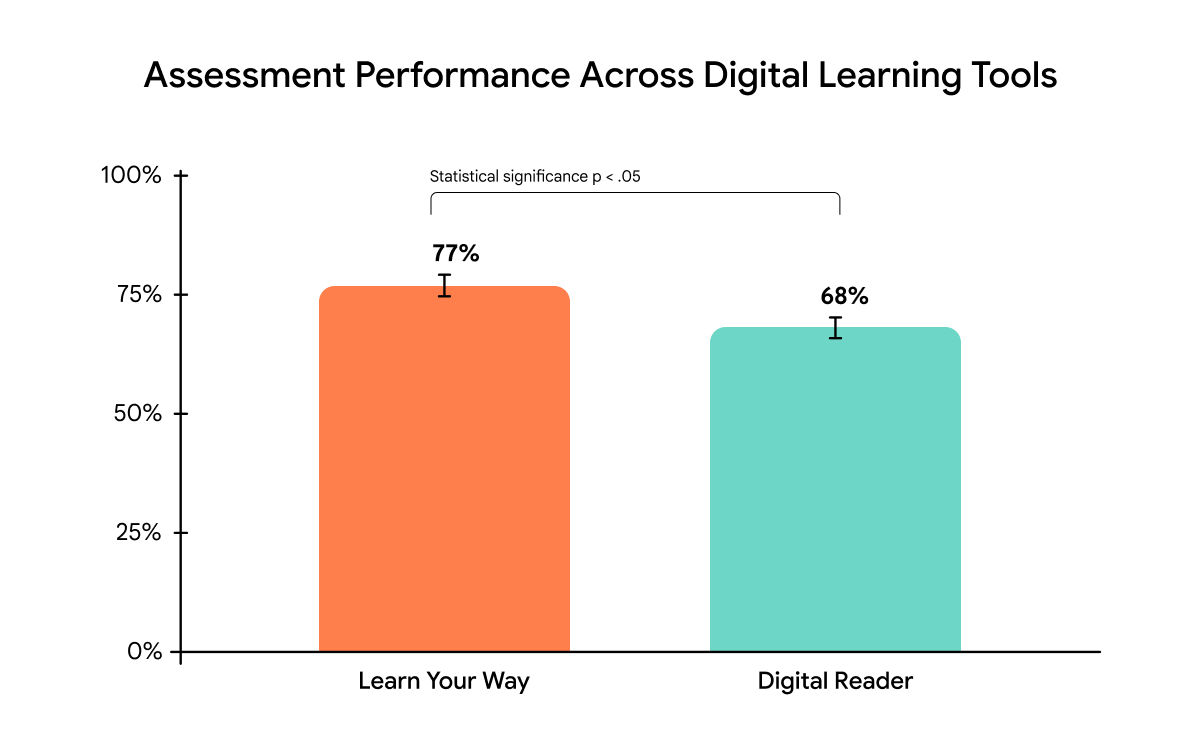
But beyond technical innovation, what stands out is the pedagogical effectiveness. A randomized study conducted with 60 high school students in Chicago compared learning through Google Learn Your Way (30 students) to that through a simple PDF reader (30 students). The results are clear: Learn Your Way users scored 9% higher on an immediate test, and also 9 percentage points higher on a retention test three to five days later (78% vs. 67%). Even more, 93% of students said they would want to reuse the tool, compared to only 67% for the traditional reader [1]. These figures, coupled with qualitative interviews, show that the tool not only makes learning more effective, but also more engaging and reassuring.
The Future of Personalized Education
Google Learn Your Way is not a consumer app but rather a research platform. Its goal is to explore, together with educational partners around the world, how AI can sustainably transform teaching practices. This project is part of a broader trend: the hyper-personalization of education. While tools like Khan Academy or Duolingo already use AI to adapt learning paths, Google takes the concept further by integrating multimodality and contextualization through personal interests.
In the longer term, the ambition is to create systems that continuously adapt to the learner’s progress, adjusting not only the content but also the pace, format, and examples in real time. This requires close collaboration between engineers, educators, and teachers, a collaboration that Google seems eager to foster, relying on scientifically validated learning principles.
[1] Towards an AI-Augmented Textbook
[2] Learn Your Way : Reimagining textbooks with generative AI