News
GPT-5.4 and Native Agentic Capabilities to Transform Professional Work
Discover GPT-5.4: revolutionary agentic architecture, 47% improved token efficiency. The new standard for complex automated workflows.
OpenAI has just unveiled GPT-5.4, its new model that marks a major technological breakthrough in the language model ecosystem. Unlike previous iterations, gpt 5.4 stands out for the native integration of computer control capabilities, a feature that fundamentally transforms how AI agents interact with software environments.
The timing of this announcement comes amidst intense competition between major players in generative AI, where every performance gain on professional benchmarks becomes a strategic differentiator. With gpt 5.4, OpenAI offers not only a more powerful model but also a redesigned architecture to support next-generation agentic workflows.
GPT-5.4 Thinking and GPT-5.4 Pro are rolling out now in ChatGPT.
— OpenAI (@OpenAI) March 5, 2026
GPT-5.4 is also now available in the API and Codex.
GPT-5.4 brings our advances in reasoning, coding, and agentic workflows into one frontier model. pic.twitter.com/1hy6xXLAmJ
Agentic Architecture and Native Computer Control
The most remarkable technical feature of gpt 5.4 lies in its computer-use capabilities integrated directly into the core of the model. Specifically, the system can now interpret screenshots, issue keyboard and mouse commands, and navigate autonomously within different applications. This functionality relies on automation libraries like Playwright, allowing the model to write code to control user interfaces without human intervention.
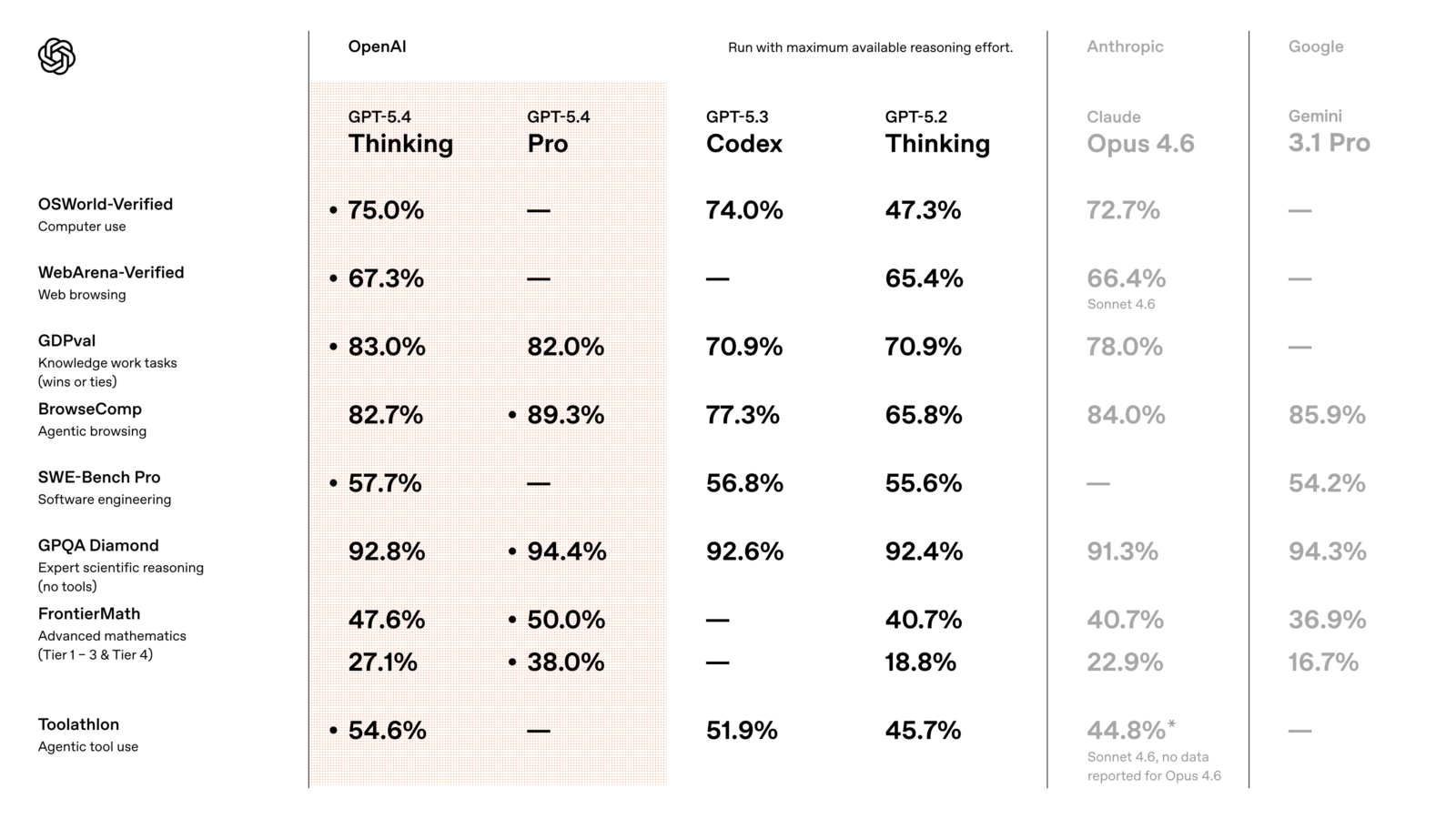
This approach marks a significant evolution compared to previous solutions that required additional abstraction layers. The performance measured on the OSWorld-Verified benchmark illustrates this advancement with a 75% success rate, demonstrating the model’s ability to accomplish multi-step tasks in real desktop environments. On WebArena Verified, gpt 5.4 also sets new records, confirming its robustness in complex web navigation.

The context window now reaches 1 million tokens in the API and Codex, allowing agents to plan, execute, and verify tasks over much longer time horizons. This context expansion is particularly useful for workflows requiring consultation of voluminous documentation or analysis of extensive codebases.
Benchmark Performance and Increased Reliability with GPT 5.4
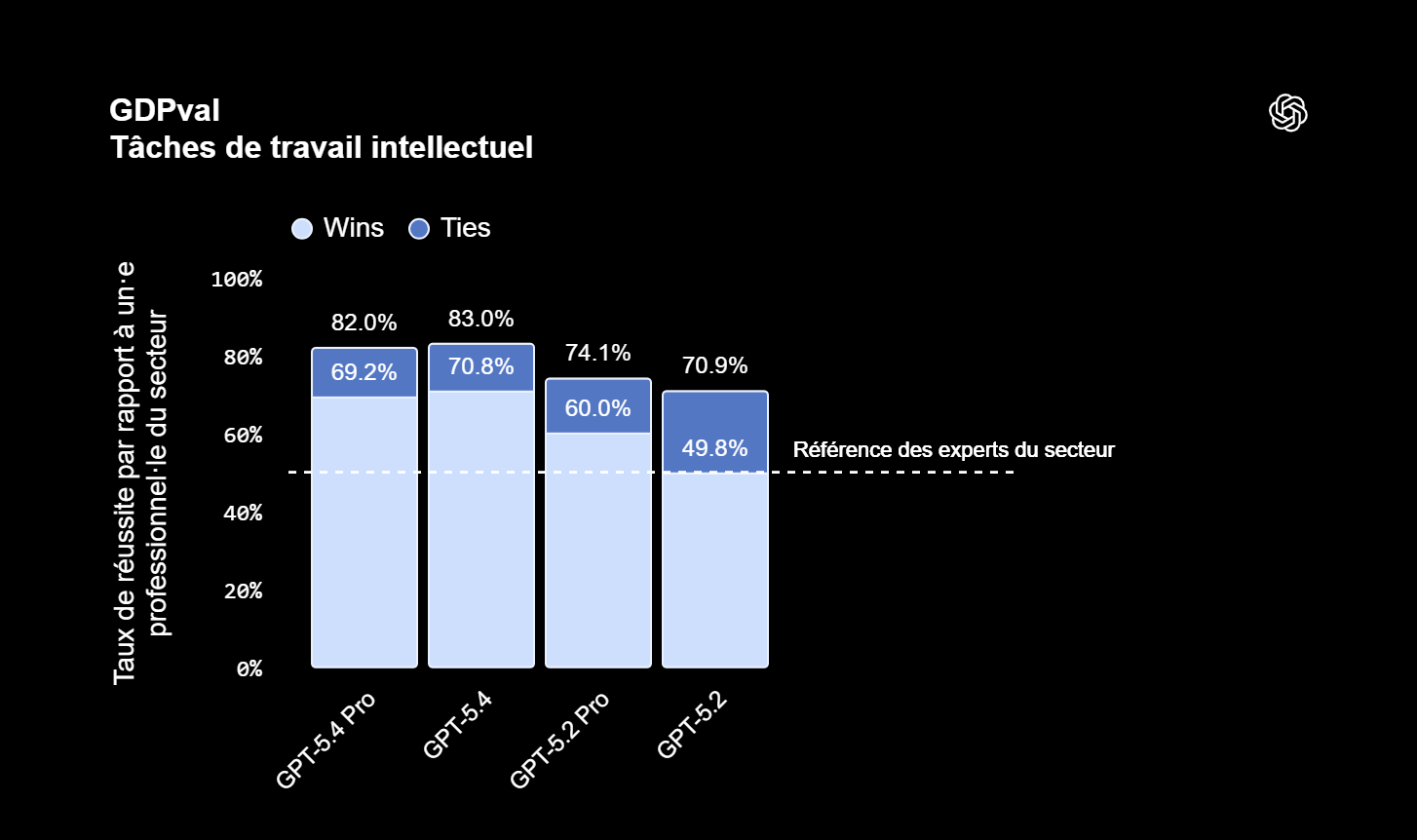
The results on the GDPval benchmark reveal a notable progression in the model’s professional work capabilities. With a score of 83%, gpt 5.4 equals or surpasses the performance of human professionals in 83% of comparisons across 44 different occupations, compared to 70.9% for GPT-5.2. These tests cover the 9 major industries contributing to the US GDP, offering a realistic evaluation of the model’s professional skills.

In the specific domain of spreadsheet modeling, performance reaches 87.3% compared to 68.4% for the previous version. This substantial improvement is explained by the integration of GPT-5.3-Codex capabilities, specialized in code, and a better understanding of the structures and formulas used in real professional environments.
Mercor’s APEX-Agents benchmark, which evaluates professional skills in law and finance, also places gpt 5.4 at the top of the rankings. On BigLaw Bench, the model achieves 91%, demonstrating its ability to structure complex transactional analyses and maintain accuracy across long legal contracts.
Hallucination Reduction and Token Efficiency in GPT 5.4
OpenAI has dedicated considerable efforts to reducing hallucinations, a persistent challenge in language models. Internal metrics reveal that gpt 5.4’s individual statements are 33% less likely to be false compared to GPT-5.2, while complete responses contain 18% fewer errors. These improvements result from adjustments in the training process and optimization of the factual verification system.
Token efficiency represents another significant technical advance. The model solves the same problems using substantially fewer tokens than its predecessors, which directly translates into reduced operational costs for API users.
In-depth web search also benefits from notable improvements, especially for highly specific queries. The model better maintains context during questions requiring prolonged thought, preventing the loss of critical information over multiple exchanges.
Evolution of Autonomous AI Agents
GPT-5.4 represents a technical advancement in the evolution of autonomous AI agents. The native integration of computer-use, combined with exceptional benchmark performance and a significant reduction in errors, positions this model as an infrastructure capable of managing complex professional workflows from end to end.
This convergence of technical capabilities paves the way for a new generation of agentic applications where intelligent automation becomes viable for a broader range of professional tasks.