News
Claude Opus 4.6: The New Benchmark in Generative AI
Claude Opus 4.6, Anthropic’s new AI model with 1M context tokens, advanced coding capabilities, and better scores on complex tasks.
Anthropic has just unveiled Claude Opus 4.6, the most advanced version of its flagship artificial intelligence model. This update represents far more than a simple incremental improvement: it redefines the standards for advanced reasoning, autonomous programming, and long-context management. For technology enthusiasts and industry professionals, Claude 4.6 Opus marks a turning point in the race for the most performant AI.
Introducing Claude Opus 4.6. Our smartest model got an upgrade.
— Claude (@claudeai) February 5, 2026
Opus 4.6 plans more carefully, sustains agentic tasks for longer, operates reliably in massive codebases, and catches its own mistakes.
It’s also our first Opus-class model with 1M token context in beta. pic.twitter.com/L1iQyRgT9x
Coding Capabilities That Push the Boundaries
One of the major advances of Claude Opus 4.6 concerns its software development skills. The model distinguishes itself through its ability to methodically plan its actions before writing code, maintain sustained focus on complex projects, and detect its own errors thanks to improved code review and debugging capabilities. Concretely, Opus 4.6 can now navigate voluminous codebases with unprecedented ease, precisely identifying necessary modifications even in complex software architectures.

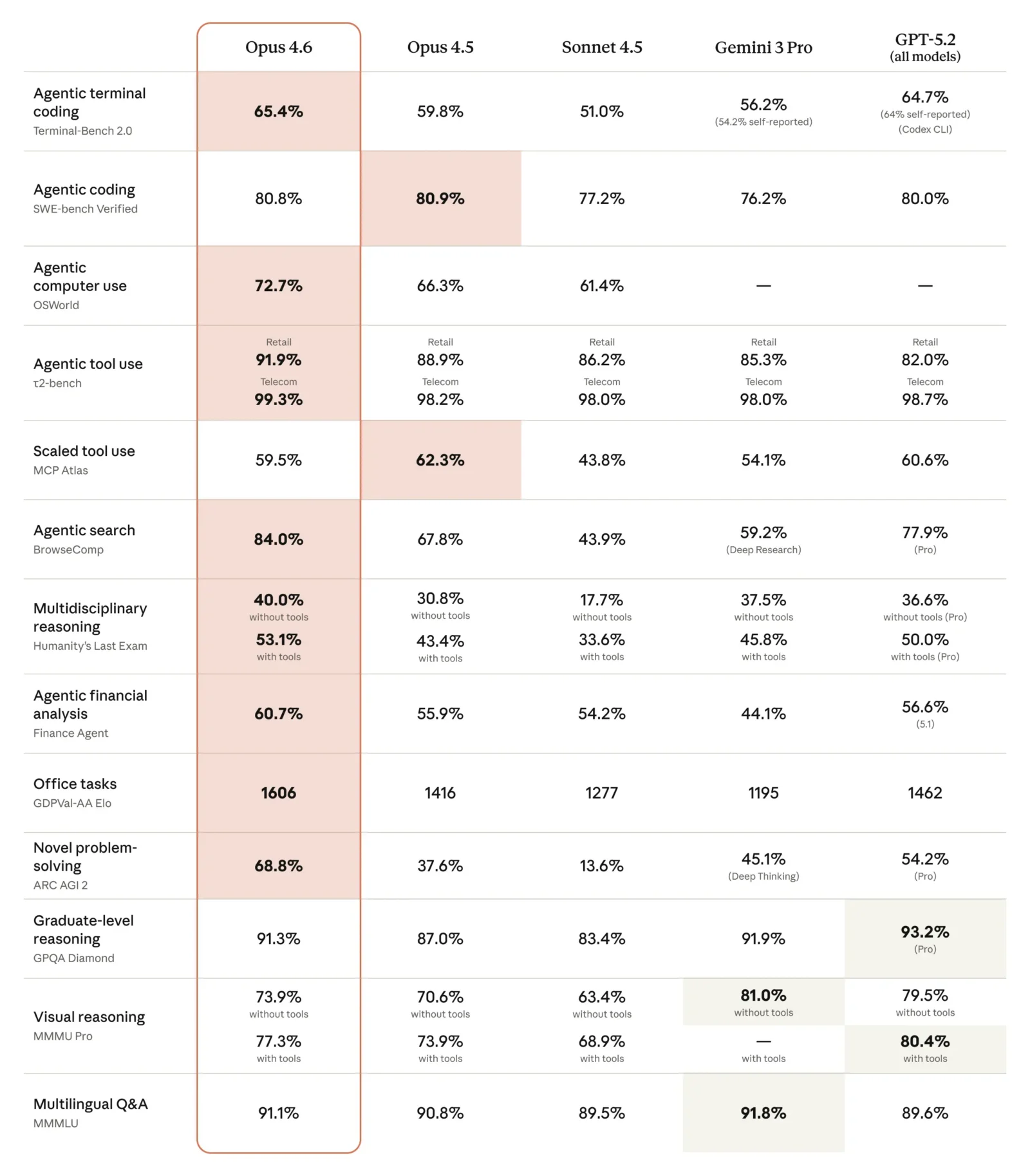
The results speak for themselves: on Terminal-Bench 2.0, a reference evaluation for autonomous coding tasks, Claude Opus achieves the industry’s highest score. This benchmark measures a model’s ability to handle real-world system tasks, and Opus 4.6’s performance confirms it surpasses all current competing models. For developers, this translates to an assistant capable of handling entire tasks, from bug diagnosis to architectural redesign, without requiring constant supervision.
A Revolutionary Context Window
Claude 4.6 Opus introduces a premier technical innovation: a context window of 1 million tokens, a first for Opus-class models. In practical terms, this means the model can process and remember the equivalent of several hundred pages of technical documentation simultaneously, without losing the thread of conversation or degrading its performance.

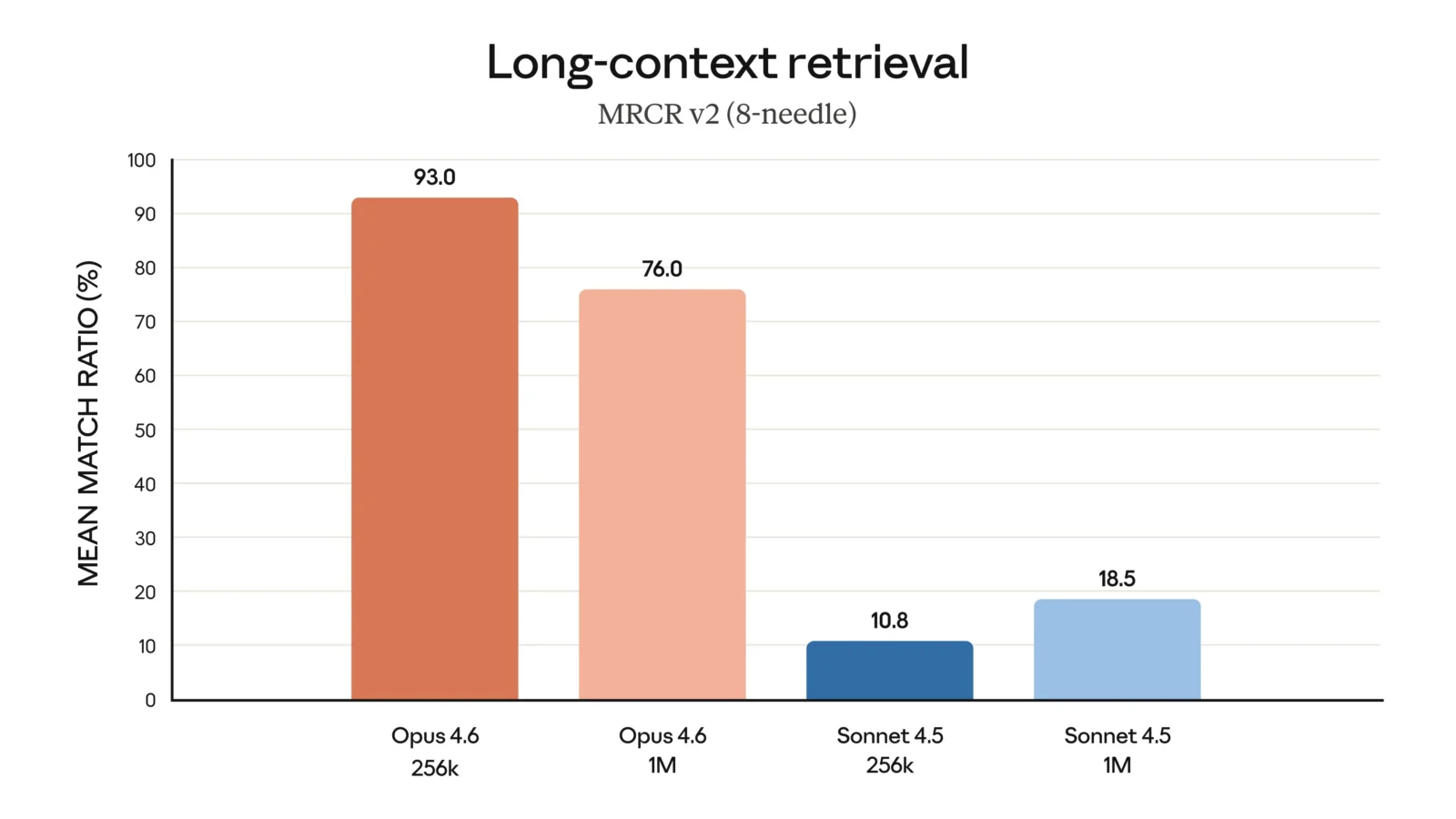
What makes this capability truly remarkable is its resistance to the “context rot” phenomenon, that progressive performance degradation when conversations lengthen. On the MRCR v2 evaluation, which tests a model’s ability to retrieve information buried in vast amounts of text, Claude Opus 4.6 achieves a score of 76%, compared to just 18.5% for Sonnet 4.5. This spectacular improvement fundamentally changes the game for applications requiring in-depth documentary analysis, such as legal research, scientific literature review, or multi-criteria financial analysis.
Peak Performance on Professional Tasks
Beyond code, Claude Opus 4.6 excels in a variety of professional domains. On GDPval-AA, an evaluation measuring performance on economically valuable tasks in financial, legal, and other sectors, Opus 4.6 surpasses the top-ranked competing model (OpenAI’s GPT-5.2) by 144 Elo points. To contextualize, this difference means that Opus 4.6 achieves better results approximately 70% of the time on these demanding professional tasks.
The model also demonstrates improved research capabilities. On BrowseComp, which evaluates the ability to locate hard-to-find information online, Claude Opus positions itself at the top of the rankings. This skill proves valuable for analysts, researchers, and professionals who need to synthesize information from multiple and dispersed sources. The combination of deep reasoning and efficient search makes Opus 4.6 a particularly suitable tool for complex workflows requiring multiple analysis steps.
Security and alignment with Claude Opus 4.6
Anthropic has not sacrificed safety for performance. On the contrary, Claude 4.6 Opus presents the strongest safety profile of all current frontier models, with low rates of misaligned behaviors such as deception or excessive compliance. Tests also reveal that this model displays the lowest rate of over-refusals among recent Claude versions, meaning it more often responds to legitimate queries without unnecessary blocking.

The company deployed particularly exhaustive safety evaluations for this version, including new tests on user wellbeing and methods from interpretability, the science that seeks to understand the internal workings of AI models. In areas where Opus 4.6 shows advanced potentially sensitive capabilities, such as cybersecurity, Anthropic developed six new detection probes to identify malicious uses. This proactive approach demonstrates a commitment to anticipating risks without stifling innovation.
Toward a New Era of Autonomous Assistants
Claude Opus 4.6 fits into a fundamental trend: the transition from conversational tools to genuine autonomous agents capable of leading end-to-end projects. With features like context compaction, which automatically summarizes long conversations to avoid limits, or adaptive effort controls, which adjust reasoning depth according to task complexity, Anthropic equips developers with a complete arsenal to build ambitious AI applications.
The arrival of this model coincides with Claude’s integration into familiar professional tools like Excel and PowerPoint, transforming these applications into environments augmented by artificial intelligence. This strategy of progressive integration into existing workflows could well accelerate the adoption of generative AI in businesses, by reducing the friction associated with learning new tools.
Claude Opus 4.6 probably represents only one step in the rapid evolution of language models, but it’s a significant step. By combining cutting-edge performance, extended context window, and rigorous safety profile, Anthropic offers a model that meets the requirements of the most demanding professional uses. For industry observers, this version confirms that Anthropic remains a major player in the race toward artificial general intelligence, with an approach that prioritizes the balance between technical capabilities and ethical responsibility.
[1] Introducing Claude Opus 4.6
