Artificial Intelligence
Understanding AI Agents: Architecture and Functioning
Discover AI agents: how they work, their architecture, and their advantages. Explore the differences between chatbots, AI assistants, and AI agents.
Artificial intelligence is reaching a new milestone today with the emergence of AI agents. These intelligent systems, capable of reasoning, learning, and acting autonomously, are radically transforming how businesses interact with their customers and automate their processes.
As solutions like Google Gemini or ChatGPT push the boundaries of this technology, it becomes essential to understand what distinguishes these agents from traditional chatbots and how they are revolutionizing the digital landscape.
What is an AI Agent?
An AI agent is first and foremost a computer program. It is a sophisticated software system that uses artificial intelligence to understand, reason, and act autonomously to achieve specific goals. Unlike traditional software that follows rigid instructions, AI agents possess a true capacity for thought and adaptation.
These intelligent systems can interact with their environment, collect and analyze data, and then make informed decisions without constant human intervention. Imagine a virtual assistant that doesn’t just answer your questions but anticipates your needs, learns from each interaction, and continuously improves its performance. This is precisely what AI agents do.
The power of these agents largely relies on foundation models like Gemini Pro 3.1, which provide them with exceptional multimodal capabilities. They can simultaneously process text, voice, images, and even code, allowing them to understand and respond to complex situations with remarkable relevance.
Distinctive Characteristics of Agents
What makes AI agents truly revolutionary are their unique characteristics that distinguish them from previous AI technologies. The first and most important is their autonomy. AI agents act independently, identifying the best action to take based on past data and executing it without continuous human supervision. This autonomy does not mean an absence of control, but rather an ability to operate proactively within defined limits.
Reasoning constitutes another cornerstone of these systems. AI agents use logic and available information to draw conclusions, make inferences, and solve problems. They analyze data, identify trends, and make informed decisions based on context and evidence.

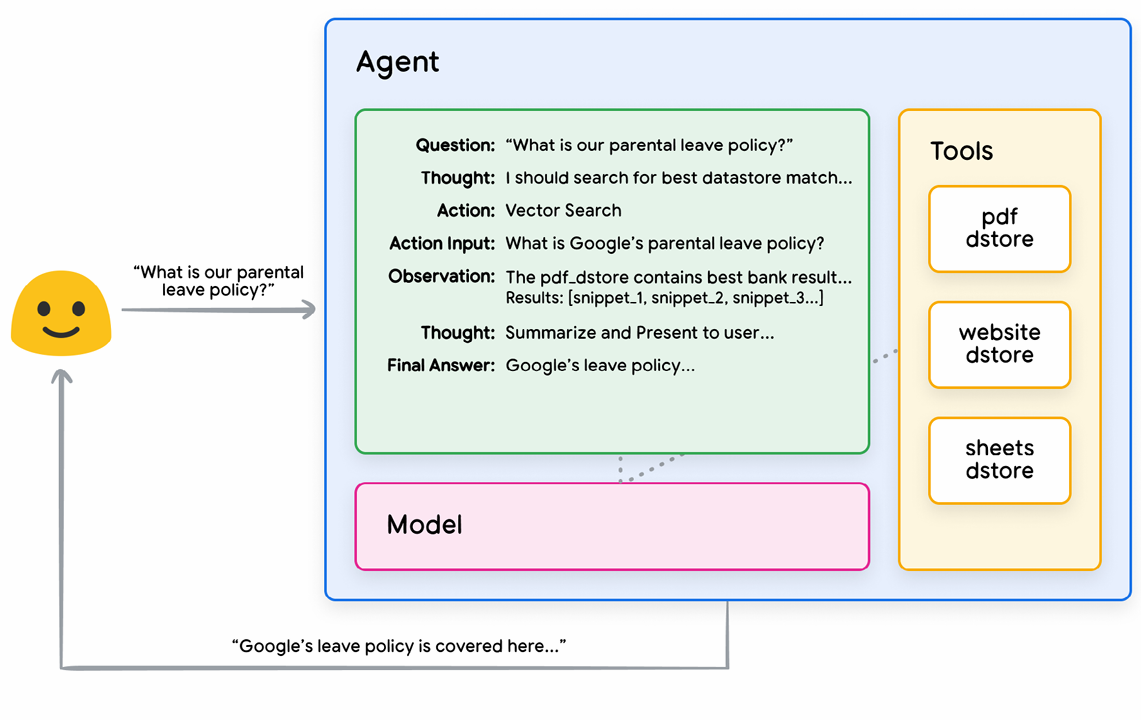
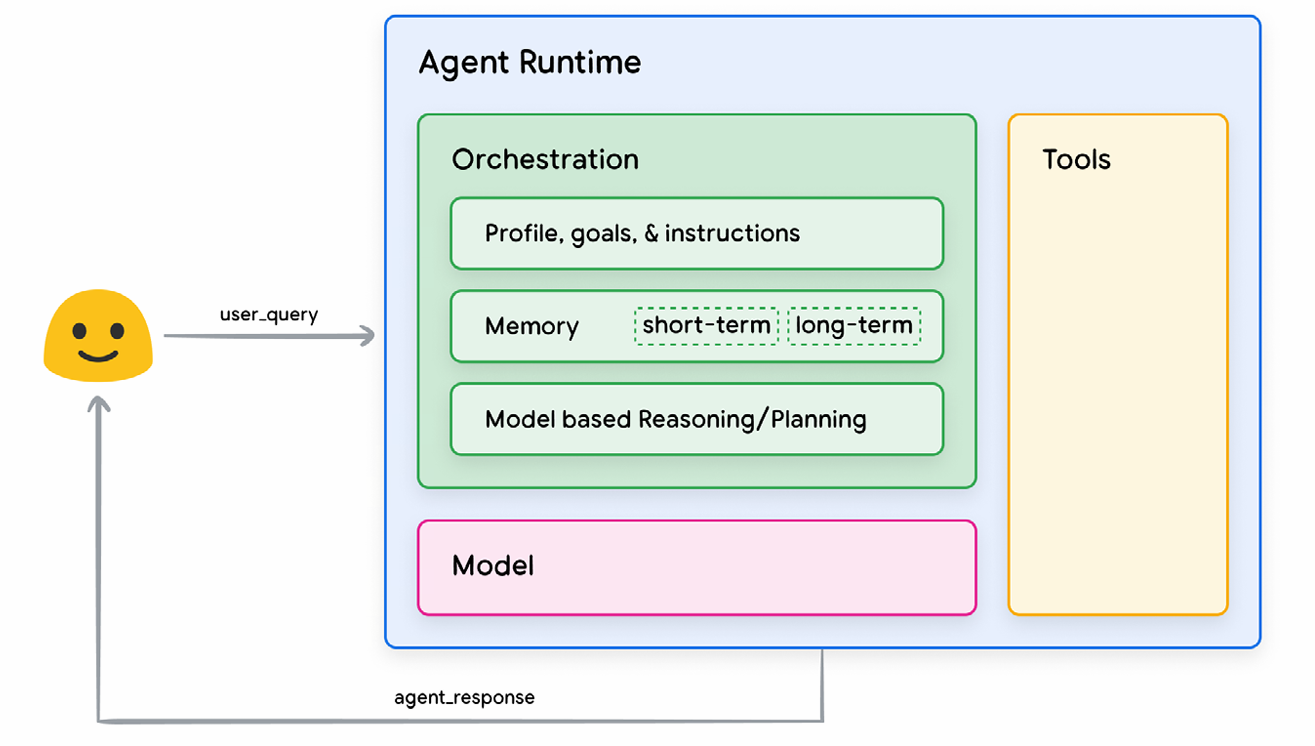
Memory also plays a crucial role in the effectiveness of AI agents. They have both a short-term memory to manage immediate interactions and a long-term memory to retain accumulated knowledge. This memory capability allows agents to maintain context over multiple conversations, learn from past experiences, and adapt their behavior accordingly.
Observation and perception represent another essential characteristic. AI agents actively gather information about their environment through various means, whether it’s computer vision, natural language processing, or data analysis. This continuous perception allows them to stay informed of changes and adjust their actions in real time.
Strategic planning also distinguishes AI agents from simple reactive systems. They can develop complex plans to achieve their goals, identifying necessary steps, evaluating potential actions, and choosing the best course of action.
How Do AI Agents Work?
The functioning of an AI agent revolves around a dynamic cycle that mimics the human thought process. This cycle begins with perception and data collection. The agent collects information from various sources, whether it’s discussions, transaction histories, or others. This collection allows the agent to actively select information relevant to its mission.
Once the data is collected, the agent enters the reasoning and decision-making phase. This is where advanced machine learning models, such as those used by Gemini AI, play a crucial role. The agent analyzes the data, identifies trends and patterns, and then determines the best action to take.
Action execution constitutes the third step of the cycle. Once the decision is made, the agent proceeds to act fluidly and efficiently. Whether responding to a request or processing a complex query, execution is designed to be fast and accurate. The agent can also use various external tools, call APIs, or interact with other systems to accomplish its mission.
At the heart of this process is a foundation model, often a large language model like the one powering Google Gemini. This model acts as the agent’s brain, enabling it to understand natural language, generate contextual responses, and reason about complex instructions.
Essential Components of an AI Agent’s Architecture
Understanding the architecture of an AI agent provides a better grasp of its power and sophistication. This architecture relies on several key components that work in synergy to create an intelligent and autonomous system.

Foundation Model
The foundation model constitutes the core of the agent. This large language model acts as the primary reasoning engine. It enables the agent to interpret natural language inputs, generate human-like responses, and reason about complex instructions. This model processes requests and transforms them into actions, decisions, or questions addressed to other system components.
Tool Integration
Tool integration constitutes another fundamental pillar. AI agents extend their capabilities by connecting to functions, software, APIs, and external devices. These tools allow them to perform concrete tasks beyond simple language processing: retrieve data, send emails, execute code, query databases, or control hardware.
The agent automatically identifies when a task requires a specific tool, then delegates the operation accordingly, subsequently interpreting the results to continue its action.
The Orchestration Layer
The orchestration layer describes the cyclical process that governs how the agent absorbs information, performs internal reasoning, and uses this reasoning to guide its next action or decision. Generally, this loop continues until the agent has achieved its goal or a defined stopping point. The complexity of this layer can vary considerably depending on the agent and the task to be accomplished.
Differences Between AI Agents, AI Assistants, and Bots
Confusion is common between AI agents, AI assistants, and traditional chatbots. However, these technologies present fundamental differences that determine their capabilities and appropriate use cases.
Traditional chatbots represent the simplest form of conversational automation. They follow predefined rules and fixed scripts, using keyword recognition and pattern matching to respond. These systems are effective for simple and predictable tasks, such as answering frequently asked questions or guiding users through standardized processes. However, they cannot understand complex contexts, adapt to new situations, or learn from their interactions.
AI assistants, like those integrated into many modern applications, represent a significant evolution. They collaborate directly with users to accomplish tasks by understanding and responding to natural language. AI assistants can reason and recommend actions, but the user retains control and makes the final decisions. They are reactive by nature, responding to demands and queries as they arise.
AI agents, on the other hand, are distinguished by their significantly higher level of autonomy and sophistication. They can perform complex multi-step actions, make decisions autonomously, and act proactively to achieve defined goals. Rather than passively awaiting instructions, AI agents anticipate needs, identify opportunities, and take initiatives.
AI Agents vs. Assistants vs. Bots
| Characteristic | Traditional Chatbots | AI Assistants | AI Agents |
|---|---|---|---|
| Operation | Predefined rules, scripts, keywords | Natural language understanding, reasoning | High autonomy, complex multi-step actions |
| Nature of interaction | Reactive (basic responses) | Collaborative and reactive (on demand) | Proactive (anticipates needs) |
| Decision-making | None (follows a set path) | Recommends, but user decides | Makes decisions autonomously |
| Adaptability | None (does not handle off-script situations) | High (adapts to context) | Very high (learns, identifies opportunities) |
| Typical use cases | FAQ, simple standardized processes | Writing assistance, search, guided task execution | Goal attainment, project management, independent initiatives |
The difference also lies in the complexity of tasks managed. While a chatbot can answer a simple question and an AI assistant can help with a guided task, an AI agent can orchestrate complex workflows involving multiple steps, systems, and stakeholders.
AI Agents vs. AI Models: A Fundamental Distinction
It is essential to understand the difference between an AI model and an AI agent, as these terms are often confused while referring to distinct realities. An AI model is essentially an inference system that generates predictions or responses based on its training data.
Its knowledge is limited to what it learned during training, and it generally processes each query in isolation, without maintaining context or session history, unless explicitly programmed to do so. Models do not natively have external tools. They rely on how prompts are formulated to guide their responses.
AI agents, in contrast, represent a major evolution compared to standalone models. They use a foundation model as their brain but augment it with a complete cognitive architecture. Their knowledge extends far beyond training data thanks to native connection with external systems via tools: databases, APIs, business software, and other real-time resources. Agents naturally manage conversation history and maintain context over multiple interaction “turns,” where each “turn” represents an incoming request and an agent’s response.
Tool implementation constitutes another major difference. While a standalone model must be manually connected to external resources by developers, agents natively integrate this capability into their architecture. They can automatically identify when to use a specific tool, call it, interpret the results, and integrate them into their reasoning.
The Future of Computing with AI Agents
AI agents, powered by advanced technologies like Gemini Pro 3.1 or Claude Opus 4.6, represent a major evolution in the artificial intelligence landscape. Their ability to reason, learn, and act autonomously opens up immense possibilities for transforming business operations, enhancing user experience, and unleashing human potential.
The era of AI agents is just beginning, and the possibilities it opens are as exciting as they are concerning. By understanding their capabilities, benefits, and differences from previous technologies, we can better prepare to fully leverage this autonomous artificial intelligence revolution.
[1] J. Wiesinger, P. Marlow, and V. Vuskovic, « Agents », Google, Whitepaper, Feb. 2025.
[2] Yao, S., Zhao, J., Yu, D., Du, N., Shafran, I., Narasimhan, K., & Cao, Y. (2022). ReAct: Synergizing reasoning and acting in language models (arXiv:2210.03629v3).