News
Stitch AI: Google Revolutionizes Interface Design with Gemini 3
Stitch Google turns your ideas into working prototypes. Discover how Gemini is revolutionizing user interface design.

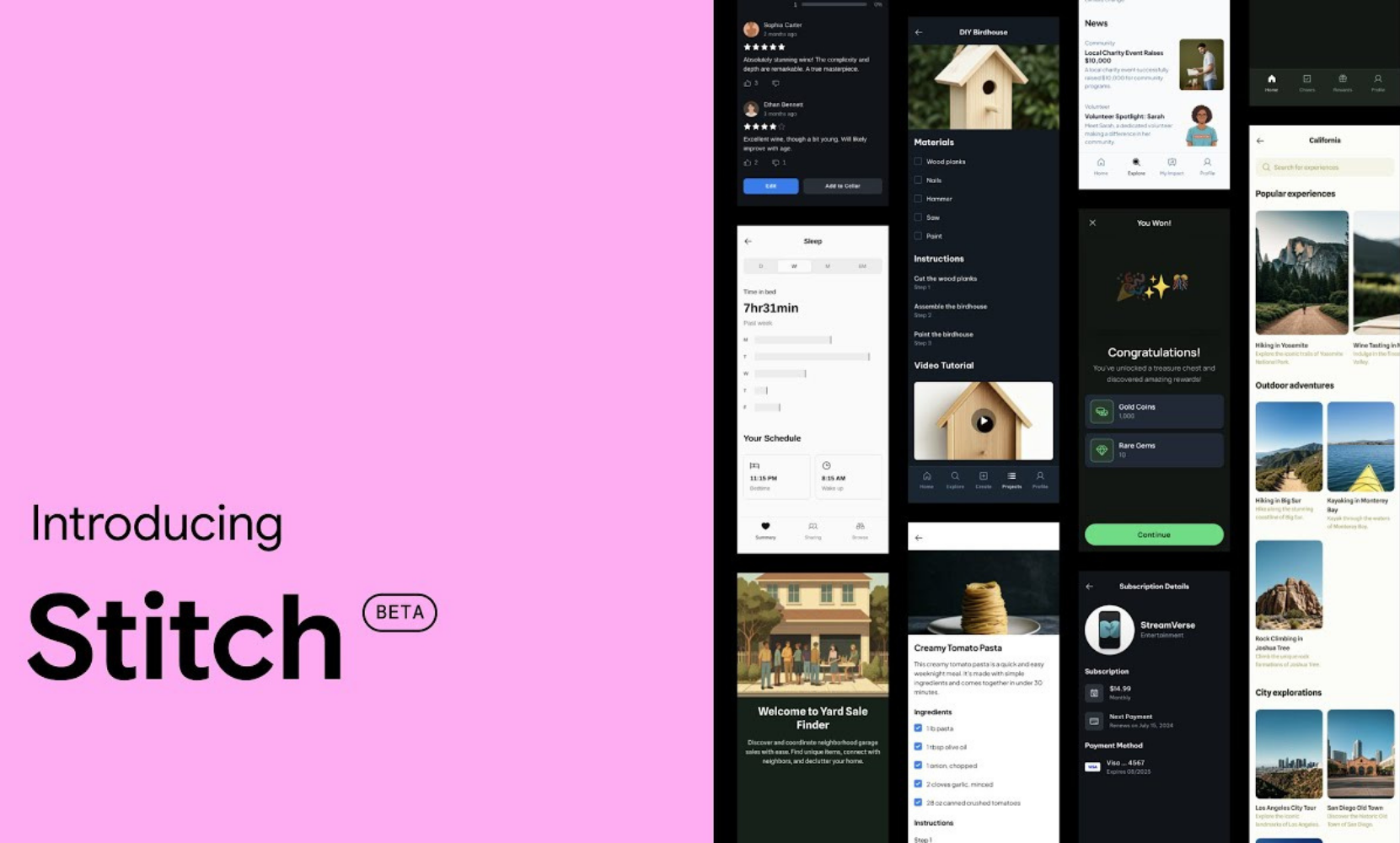
Transforming a simple idea into a functional application with just a few clicks? That’s the bold promise of Stitch, the new experimental tool launched by Google Labs. Powered by Gemini 3 artificial intelligence, Stitch AI pushes the boundaries of user interface design by enabling developers and designers to create interactive prototypes without writing a single line of code.
Stitch Google AI: A Bridge Between Imagination and Code
In today’s web development ecosystem, interface design often remains a time-consuming process requiring advanced technical skills. Google addresses this challenge with Stitch AI, a platform that democratizes application creation by leveraging the power of generative artificial intelligence.

Stitch’s operating principle is based on a revolutionary conversational approach. Users simply describe their interface idea in natural language, and the tool automatically generates a complete, functional interface. This approach recalls the evolution of conversational AI assistants, but applied specifically to the interface design domain—a sector previously little explored by this type of technology.
Since its initial launch in May 2025, Google Stitch AI has gradually established itself as a promising alternative to traditional design tools like Figma or Adobe XD. The platform stands out particularly for its ability to understand creative context and propose coherent design solutions that respect web best practices.
Gemini 3’s Arrival: A Quality Leap for Stitch
The recent integration of the Gemini 3 model marks a major turning point in Stitch AI’s evolution. This update brings substantial improvements in interface generation quality, making results even more professional and adapted to users’ real needs.
Gemini 3, the latest generation of Google’s AI models, brings finer contextual understanding and enhanced ability to interpret user intentions. Concretely, this translates into more elegant, better-structured interfaces that are more in line with current web design trends. Generated components now better respect accessibility and ergonomics principles, a crucial aspect often neglected by automated tools.
Beyond simply generating static screens, the platform also introduces a feature called “Prototypes.” This innovation allows linking different screens together to create complete, interactive user flows. Designers can thus visualize the entire user journey and test navigation before even moving to the development phase. This iterative approach greatly facilitates the detection of user experience problems early in the project.
Implications and Perspectives for Web Development
Stitch AI’s emergence fits into a broader trend of democratizing software development through artificial intelligence. Tools like GitHub Copilot for code or MidJourney for visual creation have already proven that AI can significantly accelerate creative processes without replacing human expertise.
For developers and designers, Stitch AI represents considerable time savings during the prototyping phase. Rather than spending hours creating static mockups, they can quickly generate multiple versions of an interface and iterate much more efficiently. This acceleration of the creative process allows more time to be devoted to strategic thinking and refining user experience.
However, Google Labs specifies that Stitch remains an experimental tool. Many improvements are still planned, and the company actively encourages user feedback to guide the platform’s future development. This collaborative approach reflects the desire to create a tool truly adapted to industry professionals’ needs.
Stitch AI’s availability at stitch.withgoogle.com opens new perspectives for development teams, whether composed of seasoned professionals or self-taught creators. By reducing the technical barrier to entry, Google Stitch AI could well redefine how we design tomorrow’s interfaces, placing the idea at the center of the process rather than technical mastery.