News
Claude Opus 4.5: Anthropic steps up its performance

In the breakneck race of artificial intelligence models, Anthropic has just marked a strategic turning point with the launch of Claude Opus 4.5. Unveiled on November 24, 2025, this new model positions itself as a direct response to intensifying competition in the generative AI space. While Google has just introduced Gemini 3 Pro and OpenAI continues refining its GPT suite, Anthropic is making a bold bet, favoring specialization over universality. Rather than aiming to do everything, Claude Opus 4.5 specifically targets complex cognitive tasks where performance and reliability are critical.
Targeted expertise in coding and automation with Claude Opus 4.5
Claude Opus 4.5 distinguishes itself through a deliberate focus on three core areas: software development, autonomous agent management, and office task automation. According to Anthropic, this model represents the world’s best in coding, agents, and computer use, an ambition that goes beyond mere marketing.
Early feedback from users in the preview access program confirms Opus 4.5’s expertise. Testers have highlighted the model’s ability to handle ambiguity and reason through trade-offs without requiring guidance, a capability especially valuable when debugging complex issues involving multiple systems. In software development, this contextual intelligence enables Claude Opus 4.5 not only to understand code but also to grasp the intent behind a request, delivering relevant solutions on the first try.
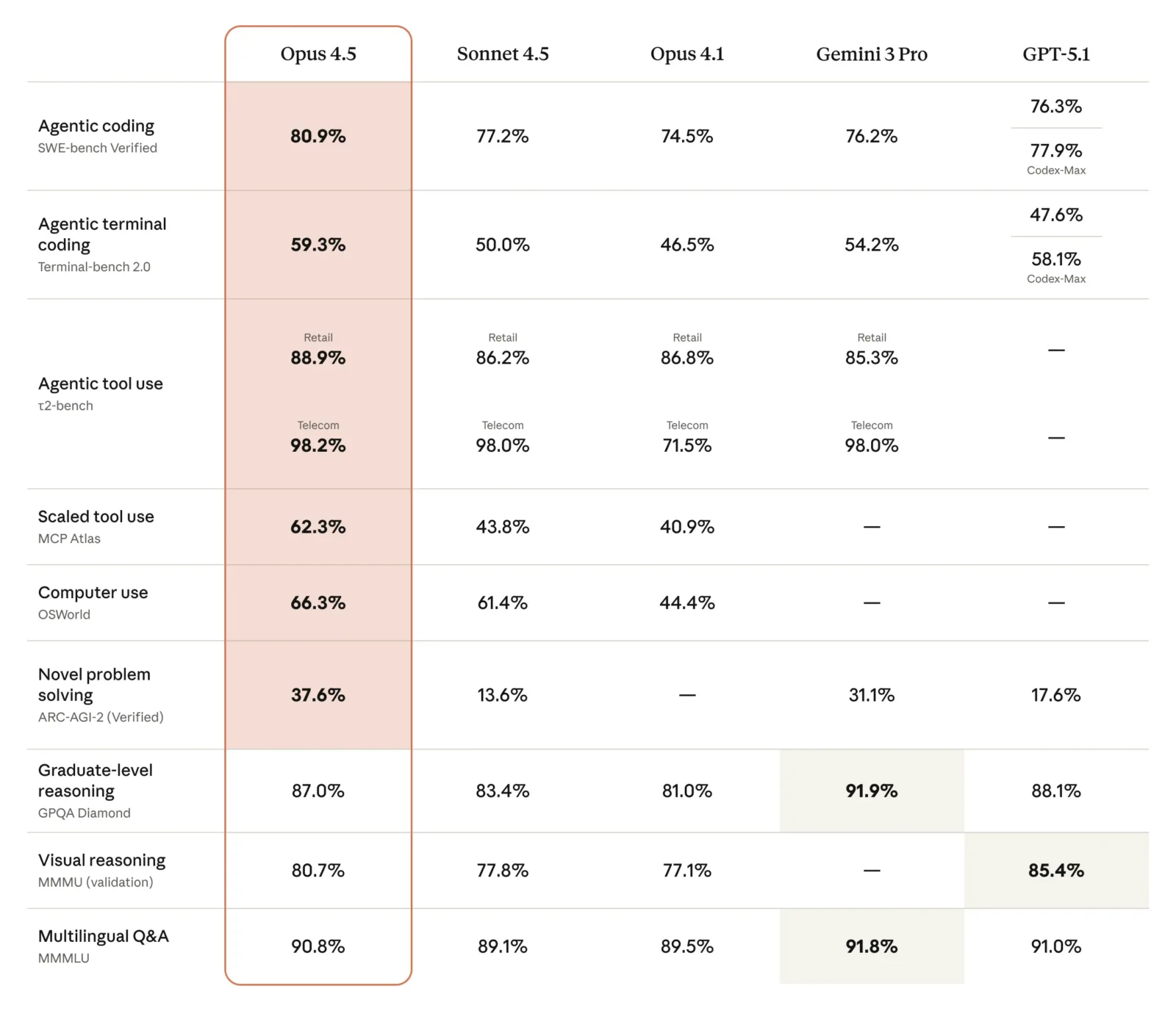
Claude Opus 4.5’s performance on standard benchmarks confirms these capabilities. The model achieves an impressive score of 80.9% on SWE-bench Verified, a test that measures real-world coding proficiency. This result places Claude Opus 4.5 at the top among current models for software development tasks, a strategic position in a market where code automation is becoming a major priority.
A game-changing cost efficiency
Beyond raw performance, Opus introduces a significant economic innovation. The model achieves higher success rates on benchmarks while using up to 65% fewer tokens, giving developers real cost control without compromising quality. This token efficiency fundamentally reshapes the value proposition of premium models, traditionally seen as expensive.
Claude Opus 4.5 is priced at $5 per million input tokens and $25 per million output tokens. At first glance, this pricing may appear high compared to direct competitors. However, Anthropic defends this strategy by emphasizing the drastic reduction in token consumption for critical workflows. For a company handling complex code refactoring or high-stakes document automation tasks, the effective cost per completed task becomes highly competitive.
This approach reflects a clear market segmentation in AI. On one side are low-cost, general-purpose models for generic use cases. On the other are specialized models like Claude Opus 4.5, designed for high-stakes scenarios where precision, traceability, and robustness are decisive. Anthropic fully embraces this strategic choice, preferring to excel in critical niches rather than attempt to cover every market segment.
Concrete applications that redefine workflows
Claude Opus 4.5’s expertise is particularly evident in three key application areas. The first arena is integration with development tools. The model is now integrated into GitHub Copilot and can run in the background via Claude Code, enabling developers to delegate lengthy coding tasks that the model handles autonomously. This capability transforms the relationship between humans and AI, from occasional assistance to genuine task delegation.

The second major application is office automation. Claude Opus 4.5 excels particularly in working with Excel spreadsheets, featuring native integration via a sidebar chat interface. The model can autonomously analyze financial data, build forecasting models, and generate pivot tables. For finance and accounting teams, this capability delivers significant productivity gains.
The third area of excellence is autonomous agent management. With a score of 66.3% on OSWorld, a benchmark measuring computer usage capabilities, Claude Opus 4.5 demonstrates its ability to navigate complex interfaces, chain context-aware actions, and adapt to unexpected situations. This capability paves the way for fully automated workflows in which AI orchestrates multiple tools and systems to achieve high-level objectives.
Claude Opus 4.5: A bet on quality over quantity
The launch of Claude Opus 4.5 arrives amid a period of consolidation in the generative AI market. While the first wave of models emphasized versatility and broad coverage of use cases, a new generation is emerging, featuring models that are more specialized and optimized for specific tasks. Anthropic fully embraces this trend, championing a premium approach built on robustness, traceability, and enterprise-grade governance.
This strategy addresses growing enterprise demand for reliable AI solutions in mission-critical contexts. Where early generic chatbots were primarily used for experimentation, organizations now seek tools capable of automating sensitive processes with enhanced security guarantees. Tests conducted by GraySwan AI confirm Claude Opus 4.5’s superior resilience against prompt injection attacks, a security concern that has become critical in professional environments.

Claude Opus 4.5’s availability on major cloud platforms, Amazon Bedrock, Google Cloud Vertex AI, and Microsoft Foundry, facilitates its adoption by large organizations. This multi-cloud distribution, combined with features such as unlimited conversations enabled by automatic summarization of long exchanges, positions the model as a day-to-day productivity tool rather than merely a technological experiment.
Anthropic carves out its path in professional AI
Anthropic articulates a clear vision for the future of generative AI: specialized models that excel at complex tasks and are purpose-built for demanding professional use cases. Its strategic bet, prioritizing quality over scale and token efficiency over the lowest price, defines a new market segmentation. For developers, financial analysts, and business teams grappling with intricate workflows, Claude Opus 4.5 represents a tangible leap forward in AI’s ability to handle ambiguity, sustain coherent reasoning over time, and deliver immediately actionable results. The key question now is whether this premium approach will attract enough organizations to firmly establish Anthropic as the go-to provider for mission-critical enterprise AI.
[1] Introducing Claude Opus 4.5